How to Prepare a Business Funding Application That Gets Approved
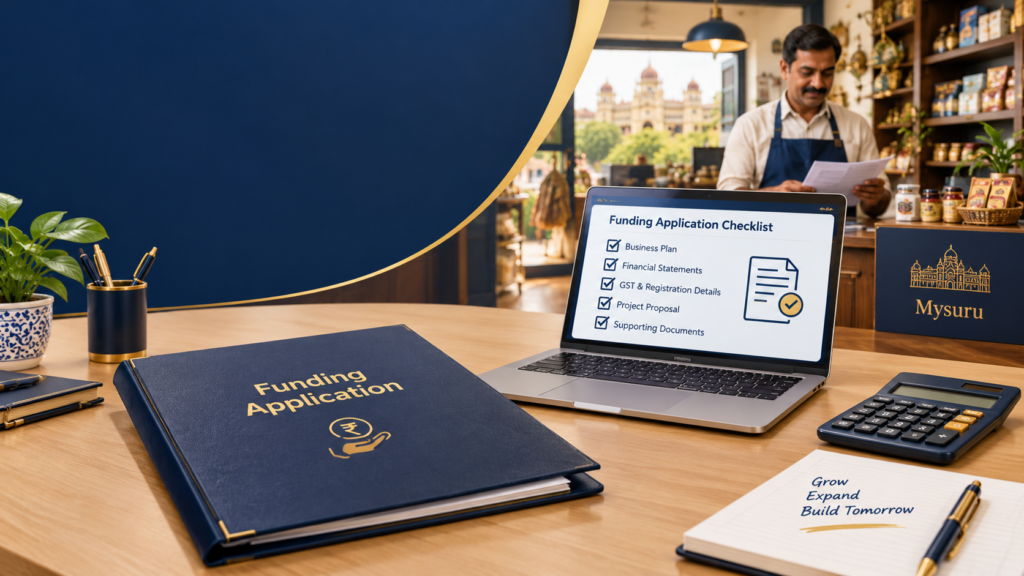
To prepare a business funding application, gather your KYC and business registration proof, 2-3 years of ITRs and financial statements, 6-12 months of bank statements, GST returns and a project report. Then check your credit score and fix errors before you apply. A complete, consistent file gets approved faster.
For traders in Mysuru, manufacturers in Hootagalli and Belagola, service firms in Hebbal, and growing businesses in Mandya, Hassan and Bengaluru, a weak application costs more than time. A rejection can lower your credit score and slow your growth plans by months. Good preparation avoids that.
Why do business funding applications get rejected?
Most rejections are not about a bad business. They come from a weak file. Lenders reject applications for reasons you can fix in advance:
A low credit score or old defaults
Missing or mismatched documents (for example, different addresses on KYC and business proof)
Bank statements that do not match reported turnover
Late or unfiled GST and income tax returns
No clear plan showing how you will repay
Banking sources list poor credit scores and documentation gaps among the most common reasons for rejection. Fix these first, and your odds improve before a lender reads a single page.
Step 1: Know what you need and why
Before you fill any form, write down three things:
The exact amount you need, with a line-by-line breakdown (machinery, stock, rent, salaries)
The purpose, because lenders price working capital, equipment and expansion loans differently
The repayment period you can handle comfortably
Vague requests like “around 10 lakh for business” slow things down. A specific, justified number shows you have done the work.
Step 2: Check and improve your credit profile
Lenders pull your credit report directly. You do not submit it, but you should check it first. Typical 2026 benchmarks reported by lenders and loan platforms:
CIBIL score of roughly 650-700 or above for most business loans
700+ for many unsecured loans, with better rates at 750+
2-3 years of business vintage for most bank and NBFC loans
Your personal score matters too, because lenders assess the promoter as well as the business.
How to improve your score before applying
Clear small overdue amounts and credit card dues
Avoid applying to many lenders at once, since each enquiry can lower your score
Correct errors in your report by raising a dispute with the credit bureau
Start 2-3 months ahead, not after a rejection
Step 3: Gather the right documents
Requirements differ by lender and loan type, but most applications need the following.
Identity and address proof (KYC)
PAN and Aadhaar of the owner or promoters
Address proof for the business and for the promoters
Recent photographs
Business registration proof
Sole proprietorship: GST registration, trade licence or Udyam registration
Partnership firm: Partnership deed and firm PAN
Pvt Ltd or LLP: Certificate of incorporation, MOA/AOA or LLP agreement, and a board resolution authorising the loan
Udyam registration if you are an MSME, since many lenders and government-backed schemes ask for it
Financial documents
ITRs for the last 2-3 years
Audited or CA-certified financial statements (balance sheet and profit and loss account)
Bank statements for 6-12 months from your current account
GST returns for the last 12 months
Loan-specific documents
Project report or business plan (especially for term loans and new businesses)
Quotations or invoices for machinery or equipment you plan to buy
Property papers and a valuation report for secured loans
Keep every detail consistent. The business name, address and PAN must match across all documents. A mismatch is one of the easiest ways to get your file returned.
Step 4: Write a bank-ready project report
A project report tells the lender how you will use the money and how you will repay it. Most lenders ask for one on term loans, and banks expect it for new units.
A strong report includes:
Business profile: What you do, who owns it, your Udyam number and your track record
Project cost and means of finance: What the funds will buy, and how much you are putting in yourself
Financial projections: Projected sales, expenses, profit and cash flow for 3-5 years
Debt Service Coverage Ratio (DSCR): The ratio of your operating income to your loan payments. Many lenders prefer a DSCR above 1.25-1.3, which means you earn comfortably more than you owe
Break-even analysis and repayment schedule
Do not copy a generic template. Lenders can tell, and numbers that do not match your bank statements raise red flags.
Step 5: Clean up your books and compliance
Your financial records are your strongest evidence. Before you apply:
File all pending GST and income tax returns
Reconcile your books with your bank statements
Explain any large, unusual transactions in writing
Keep your accounts up to date, not 6 months behind
Lenders compare turnover in your GST returns, ITRs and bank statements. If the three tell different stories, expect questions or a rejection.
Step 6: Choose the right lender and loan type
Banks, NBFCs and digital lenders differ in speed, documentation, cost and risk appetite. Match the loan to your need. Large, long-term needs usually suit secured loans, while quick working capital often suits unsecured or government-backed collateral-free loans. Compare the total cost, including processing fees, prepayment charges and any guarantee fee
Step 7: Review before you submit
Run a final check:
Are all forms signed and complete?
Do names, addresses and PAN match everywhere?
Are bank statements recent and unaltered?
Does your requested amount match the project report?
Have you kept copies of everything you submitted?
How PM Associates helps you prepare your funding application
PM Associates is a multidisciplinary firm of accounting, taxation, audit and financial professionals in Chamundipuram, Mysuru. We prepare your application the way a lender will read it.
Lender-ready books: Our accounting services keep your records accurate, current and compliant.
1. What documents do I need for a business loan application?
You typically need KYC, business registration proof, ITRs, financial statements, bank statements and GST returns. Term loans also need a project report, and secured loans need property or asset papers.
2. What credit score do I need for a business loan?
Most lenders look for a CIBIL score of about 650-700 or higher. Unsecured loans often need 700 or above, and higher scores usually earn lower interest rates
3. Do I need a project report to get a business loan?
Yes, for most term loans and new businesses. The report shows how you will use the funds and repay them, and it should include projections and DSCR.
4.Can I get a business loan without ITR?
It is harder, but some lenders accept alternative proof such as bank statements and GST returns. Expect higher rates, lower limits and stricter checks. Filing your ITRs gives you far more options.
5. How long should I prepare before applying?
Start 2-3 months ahead. This gives you time to improve your credit score, file pending returns, correct report errors and build a proper project report.