Cash Flow Funding for Businesses: Options, Costs and How to Choose

Cash Flow Funding for Businesses: Options, Costs and How to Choose

Cash Flow Funding for Businesses: How to Cover the Gap Between Bills and Payments

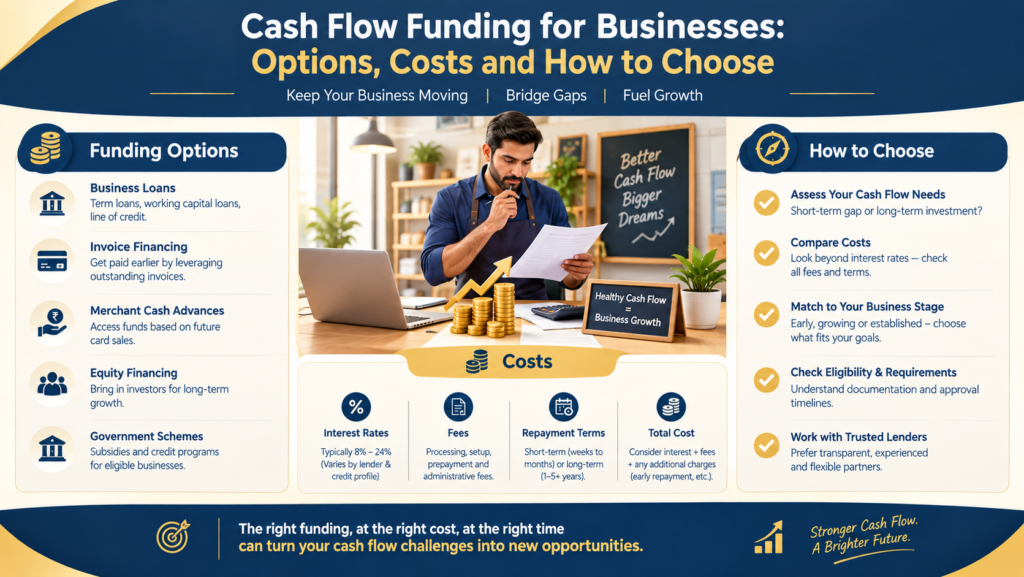
Cash flow funding is short-term finance that covers the gap between paying your costs and getting paid by customers. Options include overdrafts, cash credit, invoice discounting, short-term business loans and credit-guaranteed bank loans. The right choice depends on your gap, your paperwork and what you can afford to pay.

Profit on paper does not pay wages. If you run a manufacturing unit, a service firm, a contracting business or a clinic in Mysore (Mysuru), you have felt this. You invoice in March. The customer pays in May. Rent, salaries and GST fall due in April.

GST is usually payable on the invoice, not on the payment. So you can owe tax on a sale before the money reaches your account. That is a cash flow problem, not a profit problem. This guide shows how to size the gap, compare your funding options and prepare an application a lender can approve.

What cash flow funding is (and what it is not)

Cash flow funding bridges a timing gap. It pays today’s costs while you wait for money you have already earned.

It does not fix a business that loses money on every sale. If your costs stay higher than your revenue, borrowing only delays the problem. Before you borrow, ask one question: will the money come in? If the answer is yes, and the only issue is when, funding makes sense.

Measure the gap before you borrow

Do not guess your funding need. Build a simple 13-week cash flow forecast:

  1. List the cash you expect to receive each week for the next 13 weeks.
  2. List the cash going out in the same weeks: purchases, wages, rent, EMIs, GST, TDS and advance tax.
  3. Subtract outflows from inflows, week by week, and carry the balance forward.
  4. Find the lowest point. That lowest balance is your peak funding need.

Next, calculate your cash conversion cycle. This number shows how many days your cash stays tied up:

  • Days sales outstanding (how long customers take to pay you): 60 days
  • Plus days of inventory (how long stock sits before it sells): 30 days
  • Minus days payable (how long you take to pay suppliers): 20 days
  • Cash conversion cycle: 70 days

In this example, every rupee you spend comes back after 70 days. A funding facility must cover that period.

Cash flow funding options

Overdraft and cash credit limits

These are revolving limits from a bank. You draw when you need cash and repay when customers pay. You pay interest only on the amount you use. They suit regular, repeating gaps. Expect the bank to review the limit each year and to ask for security in many cases.

Invoice discounting and factoring

With invoice discounting, you borrow against your unpaid invoices and still collect the money from your customer. With factoring, a finance company also takes over collection. Both release cash within days instead of weeks. Both work best when your customers are established businesses with a record of paying. You pay a discount charge for the days the money is advanced.

TReDS

TReDS is a set of electronic platforms authorised by the RBI. An MSME seller uploads an invoice raised on a large buyer, and financiers bid to pay the seller early. It suits MSMEs that sell to large corporates, public sector units or government departments. Check that your buyer is registered on the platform before you plan around it.

Short-term and unsecured business loans

Banks and NBFCs offer short-term loans with fixed repayments. Many NBFCs do not ask for property as security. They lean on your GST returns and bank turnover. These loans suit a one-time gap or an urgent need. They usually cost more than a secured bank limit.

Collateral-free bank loans backed by CGTMSE

The Credit Guarantee Fund Trust for Micro and Small Enterprises (CGTMSE) guarantees eligible loans to micro and small enterprises. Because the lender holds a guarantee, it can lend without collateral. As per the CGTMSE FAQ, credit facilities can go up to ₹10 crore per borrower, subject to the scheme rules and the ceiling of each lender.

Remember three points:

  • You apply through a Member Lending Institution such as a bank or NBFC. You do not apply to CGTMSE directly.
  • The guarantee protects the lender. You still owe the full amount.
  • The lender still checks your business and repayment capacity. Collateral-free does not mean automatic approval.

The lender pays an annual guarantee fee and may pass it on to you. Trading businesses should ask the lender whether cover applies to them.

Supplier terms and customer advances

You can also reduce your funding need without borrowing. Ask customers for advances on large orders. Offer a small discount for early payment. Negotiate longer terms with suppliers.

Check the law before you stretch supplier payments. Under the MSMED Act, a buyer must pay a micro or small supplier within 15 days, or within the period agreed in writing, which cannot exceed 45 days. Income tax law also links your deduction for that purchase to timely payment.

How the options compare

Finance OptionBest Suited ForKey Considerations
Overdraft or Cash CreditBusinesses with regular and recurring working capital gapsAnnual renewal, security requirements, and bank limits may apply
Invoice Discounting or FactoringBusinesses with substantial credit sales to reliable customersDiscounting charges and the creditworthiness of buyers should be considered
TReDS FinancingMSMEs supplying goods or services to large corporates or government buyersAvailable only for eligible invoices accepted by buyers on the TReDS platform
Short-Term or Unsecured LoanBusinesses facing one-time cash flow shortages or urgent funding needsUsually involves higher interest costs and fixed repayment schedules
CGTMSE-Backed Bank LoanMicro and small enterprises seeking finance without traditional collateralSubject to bank assessment, eligibility requirements, and applicable guarantee fees
Supplier Credit and AdvancesBusinesses that can negotiate flexible payment terms with suppliersConsider MSME payment regulations and the impact on supplier relationships

How to prepare your application

A clean file speeds up every lender’s decision. Gather these documents:

  • KYC and registrations: PAN, Aadhaar, GST registration, Udyam certificate and your partnership deed or incorporation papers
  • Bank statements: Recent statements, usually 6 to 12 months
  • Tax filings: GST returns and income tax returns for the last two to three years
  • Financial statements: Balance sheet and profit and loss account, plus provisional figures for the current year
  • Debtors and creditors list: Who owes you, who you owe, and how old each bill is
  • Cash flow forecast: The 13-week forecast above, plus projected annual turnover
  • CMA data: For larger limits, lenders often ask for Credit Monitoring Arrangement (CMA) statements
  • Existing loans: Sanction letters and repayment schedules

Make sure your GST sales, income tax turnover and bank credits tell the same story. Mismatches are among the most common reasons for delay.

How PM Associates helps businesses in Mysore

PM Associates is a multidisciplinary firm of Chartered Accountants and Company Secretaries in Chamundipuram, Mysore. The firm offers accounting, audit, GST, income tax and loan arrangement services in one place.

Cash flow funding starts with clean numbers. A team of Chartered Accountants can:

  • Reconcile your GST returns, income tax filings and bank statements
  • Help you prepare projected financials and a cash flow forecast
  • Match your gap to the right type of facility
  • Help you assemble the document file before you approach a lender

PM Associates arranges finance through lenders. The lender decides approval, interest rate and terms.

FAQs:

1. What is cash flow funding?

Cash flow funding is short-term finance that covers the gap between paying your costs and receiving customer payments. It includes overdrafts, cash credit, invoice discounting and short-term business loans.

An existing overdraft or cash credit limit is usually the fastest, because the bank has already sanctioned it. Invoice discounting and NBFC loans can also move quickly when your GST returns and bank statements are clean. Speed often costs more, so compare the total charges.

Yes, in some cases. Banks can lend without collateral to eligible micro and small enterprises when CGTMSE guarantee cover applies, and NBFCs offer unsecured loans based on GST and bank records. The lender still assesses your repayment capacity.

They overlap. Working capital finance funds day-to-day operating needs. Cash flow funding is the wider term for any short-term finance that fixes a timing gap, including invoice discounting.

Lenders usually ask for KYC and business registration papers, recent bank statements, GST returns, income tax returns, financial statements and a cash flow projection. Requirements vary by lender and by facility.

Get Expert Cash Flow Funding Help in Mysore

P M Associates provides loan arrangement along with accounting, GST, income tax, audit, and other financial services.

If you want to compare cash flow funding options and find a financing option suitable for your business, contact P M Associates in Mysore.

P M Associates

Phone: +91-9964198401
Email: info@pmassociatesmysore.com
Address: Shop No. C-7, Keerthi Plaza, Chamundipuram, Mysore, Karnataka 570004

You can also find our website on Google.